fig. p-03 · the systems under a venture fund
the problem
I joined Biome as an entrepreneur in residence, to test whether the Five Labs thesis could hold as a business. It could not, and within months I had moved into the product team, because the fund had a more concrete problem in front of it: a venture fund's output is judgment, and the judgment is only as good as the machinery that decides who the fund meets, in what order, and how prepared it is when it does.
I am the only technical person on that team, which turned out to be the constraint that mattered: every system had to be able to explain itself to a person who would never read the code.
what I did
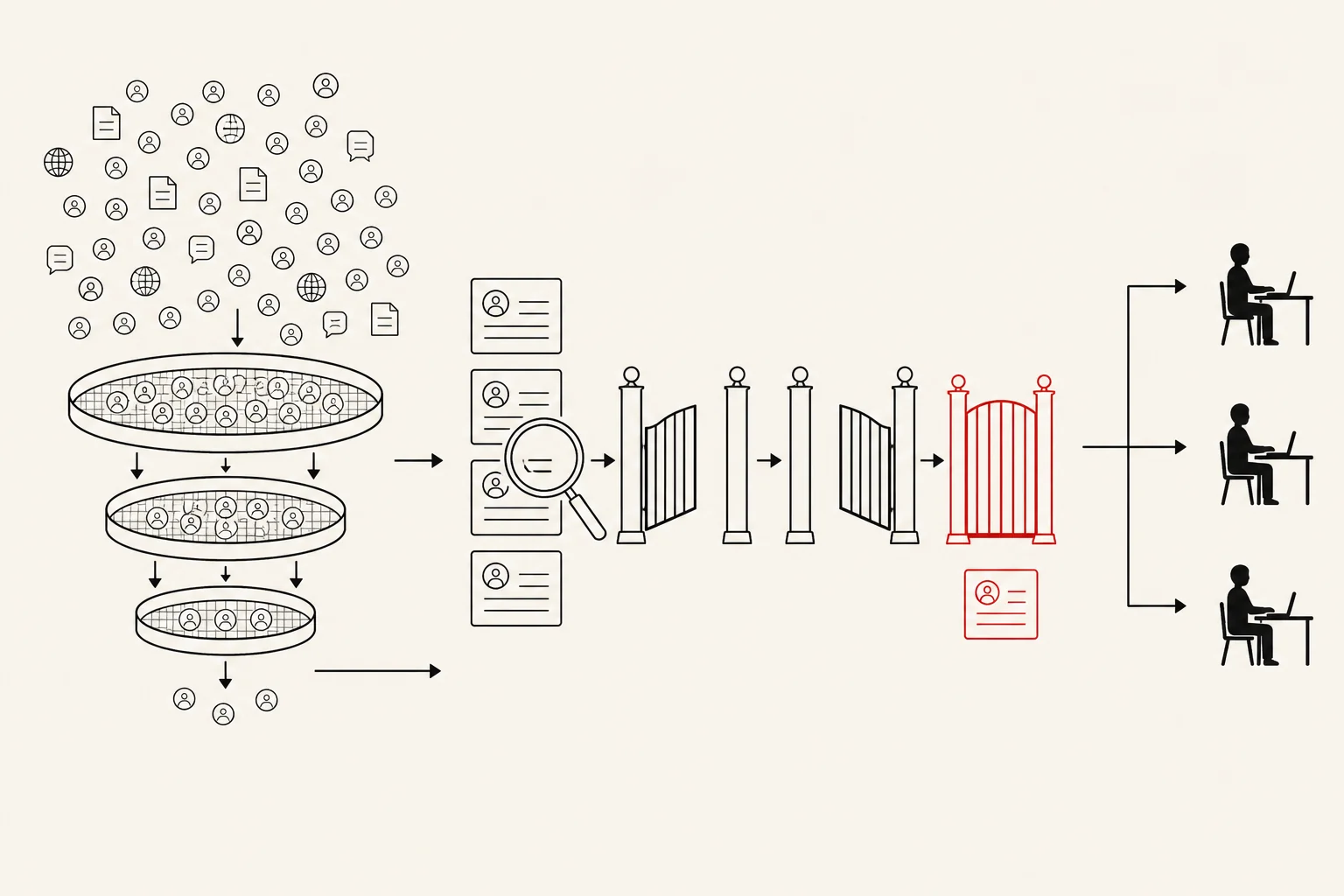
The sourcing platform is the fund's front door, end to end. It gathers public signals in a fixed order, builds a research brief on every founder it surfaces, what they built before, what their role actually was, whether the signal survives a closer look, and routes each brief to the team member whose preferences fit. Work that took days of manual scouring now happens in hours; the team's own measure is twenty-plus hours a week returned, and the fund reaches founders earlier than a manual pipeline allows.
The evaluation agent picks up where sourcing ends. Given a company, it researches the problem being solved, the competitive set and how each player approaches it, what customers pay and what they would pay, and what the incumbents are doing, and returns the financial, product, and market intelligence a deal discussion needs, in a form the team can interrogate rather than a summary it has to trust.
Around those two sit the quieter systems: CRMs and company databases designed to stay coherent as the organisation grows, and a knowledge system built on Onyx, the open-source retrieval stack, so the fund's accumulated context stays findable instead of evaporating into inboxes. The product names and the specifics are Biome's. The outcomes are the part I can show.
method
The first version of the ranking scored every piece of information and averaged the pile. The language models inflated the scores, and the priority tags stopped separating anyone. I replaced averaging with sequential fail-stop checks and validated the output against the team's own judgment. Where the machine and the team disagreed, the fix was almost always tighter language in the criteria, not a smarter aggregate.
The specific criteria are the fund's own and stay private. The code is private. The method is not.
what I found
A ranking a partner cannot see the reasons for is a ranking they will quietly stop using. That is the legibility finding this site keeps coming back to, and I learned it here, not in a paper: an internal tool earns its keep only if the team keeps choosing it over the manual path, week after week, and they only do that when the research pass is trustworthy enough to act on and the routing respects how each person actually works.
open
How much of sourcing judgment can be made explicit before it flattens into a checklist. Where a partner's taste resists automation and where it welcomes it.